
Native American Heritage Month for Grades 4–6: A Ready-to-Teach 3-Week Plan
November is Native American Heritage Month, and a lot of us want to do more than a coloring page and a paragraph about “the first Thanksgiving.” Students in grades 4–6 are ready for real questions, real evidence and real people who are still here today.
This is the plan we built for that: three weeks, nine lessons, and one question running through all of it.
Who lived here first, and how did they do it?
Three ground rules before you start
- Be honest about scale. Hundreds of nations lived across North America. Nobody can teach all of them in a month, so we say it out loud: “There were hundreds of nations. We’re studying a few closely.” That’s what historians actually do, and students respect being told the truth.
- Use each nation’s own name. Students may know “Iroquois” from a book. We say that once, then use Haudenosaunee, the name the nations use for themselves. Week 3 does the same with the Tlingit word ku.éex’.
- Use the present tense when it’s true. The Haudenosaunee Grand Council still meets. Wampum is still used today. Ending a lesson with “they’re still here” heads off the idea that Native nations only exist in history books.
Week 1: Regions and geography
Students learn one reusable lens: home, food, clothing, geography. The first lesson models it once, start to finish, on the Haudenosaunee of the Eastern Woodlands. Why longhouses? Because wood was everywhere, and a big shared home was the answer to hard winters.
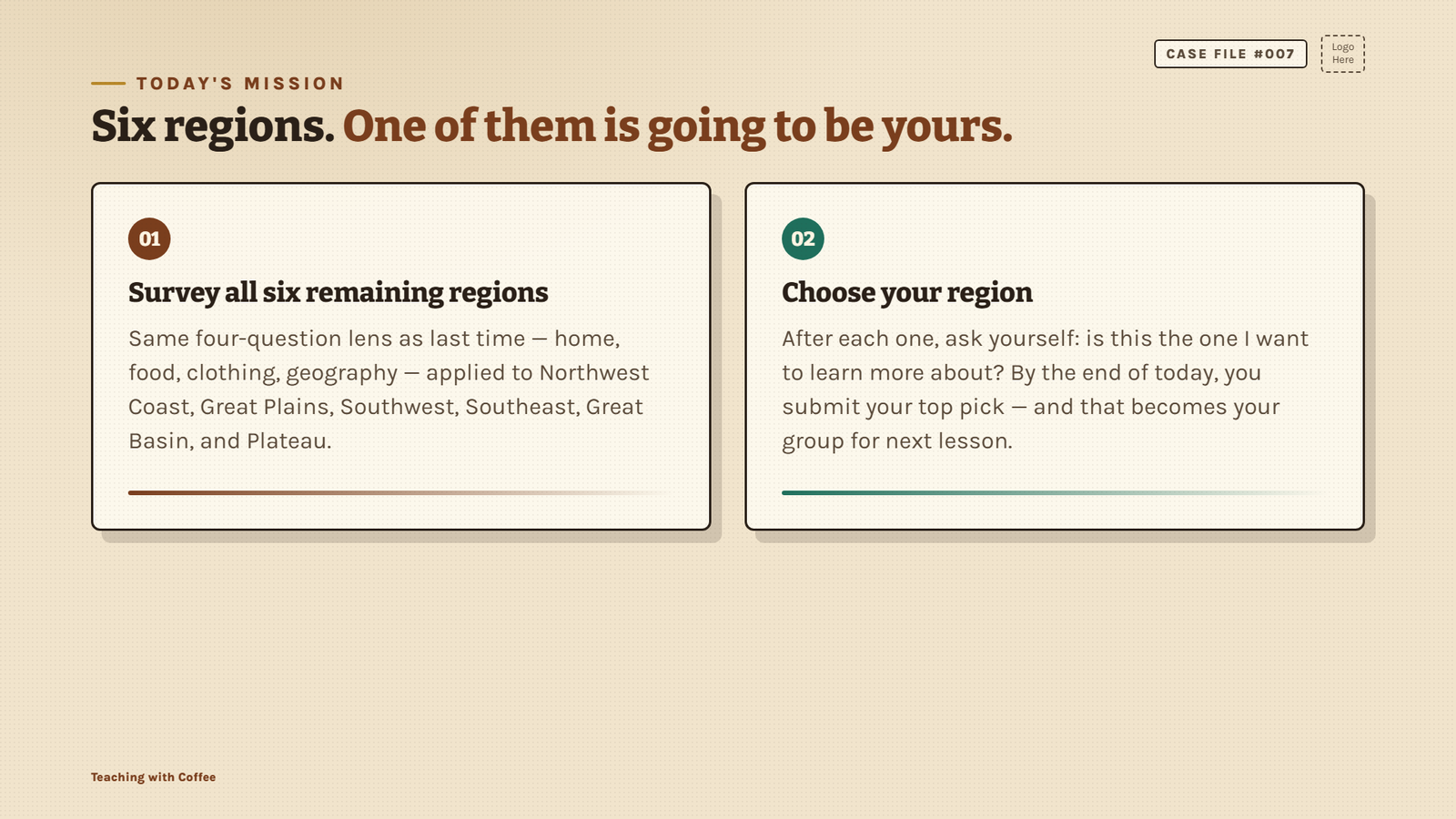
The second lesson runs the same four questions across six more regions, from Tlingit cedar plank houses on the Northwest Coast to Hopi pueblos on the desert mesas. Then each student picks a region to become the expert on. In the third lesson, groups write claim-and-evidence sentences and teach their region to the class.
Week 2: Government
Same nation, new lens. Students ask four civics questions of the Haudenosaunee Confederacy: Who chooses the leaders? How are decisions made? Where are the rules kept? Who has a voice? Then they ask the same four questions about the United States.
The rule for the whole week is compare, don’t rank. Neither government is “better.” Where they differ, students explain why each way makes sense for its people. Two short primary sources, one from each government describing itself, give students real practice with point of view.
Week 3: Economics
Detectives say “follow the money,” so our host does, and finds that the thing many books call “Native American money” was never money to the people who made it. Students compare Haudenosaunee wampum, which holds words and promises, with the Tlingit ku.éex’, a memorial ceremony that many books call a potlatch. The lesson explains that name change for students and teachers alike. The week ends with the unit’s final claim: what made something valuable, and was it money?
How the lessons run
- A short video opens every lesson. Piper Hunter, our detective host, launches the case, then you take it from there.
- Interactive slides that work offline. Each presentation opens in any web browser, with no logins, no accounts and no student data.
- A printable path for every lesson. Worksheets, fact sheets and writing prompts reach the same goal with no device at all.
- Scripted teacher lesson plans, with timing, a grades 4–6 pacing guide and a rubric, so a sub can run it too.
- Writing built in. Every week ends with a claim-and-evidence paragraph, plus a one-page Grade 6 extension.
A November calendar that works
- Week of Nov 2: Week 1, regions and geography
- Week of Nov 9: Week 2, government
- Week of Nov 16: Week 3, economics, finished before Thanksgiving break
Short on days? Each week is three lessons, and the lesson plans mark where to split a lesson across two class periods.
Try the first lesson free
Week 1’s first lesson, “What the Land Gives You,” is free. It’s the easiest way to see how the videos, slides and printables work in your room before you buy anything.
Get the free lesson on TPT · See all three weeks · Get the 3-week bundle
Over the next three Sundays, we’ll take a closer look at each week: Native American regions (Nov 8), the Haudenosaunee Confederacy and U.S. government (Nov 15), and wampum belts and the ku.éex’ (Nov 22).
at the end of each November post. Kit form 10054634, social studies tag 24700581. –>Get a free Piper Hunter case file
Join our email list and we’ll send a free social studies lesson, plus first access to new weeks as they’re released.