Teaching the Haudenosaunee (Iroquois) Confederacy and U.S. Government Side by Side
Most textbooks give the Haudenosaunee Confederacy one paragraph, and that paragraph is often about whether it “inspired” the U.S. Constitution. There’s a better lesson hiding underneath: two governments that solved the same problem in two different ways.
The problem? How do separate groups govern themselves together?
Start with the name
Students may know these nations as the Iroquois. That’s an outsiders’ name. The nations call themselves Haudenosaunee, which means “People of the Longhouse.” Say that once, then use it.
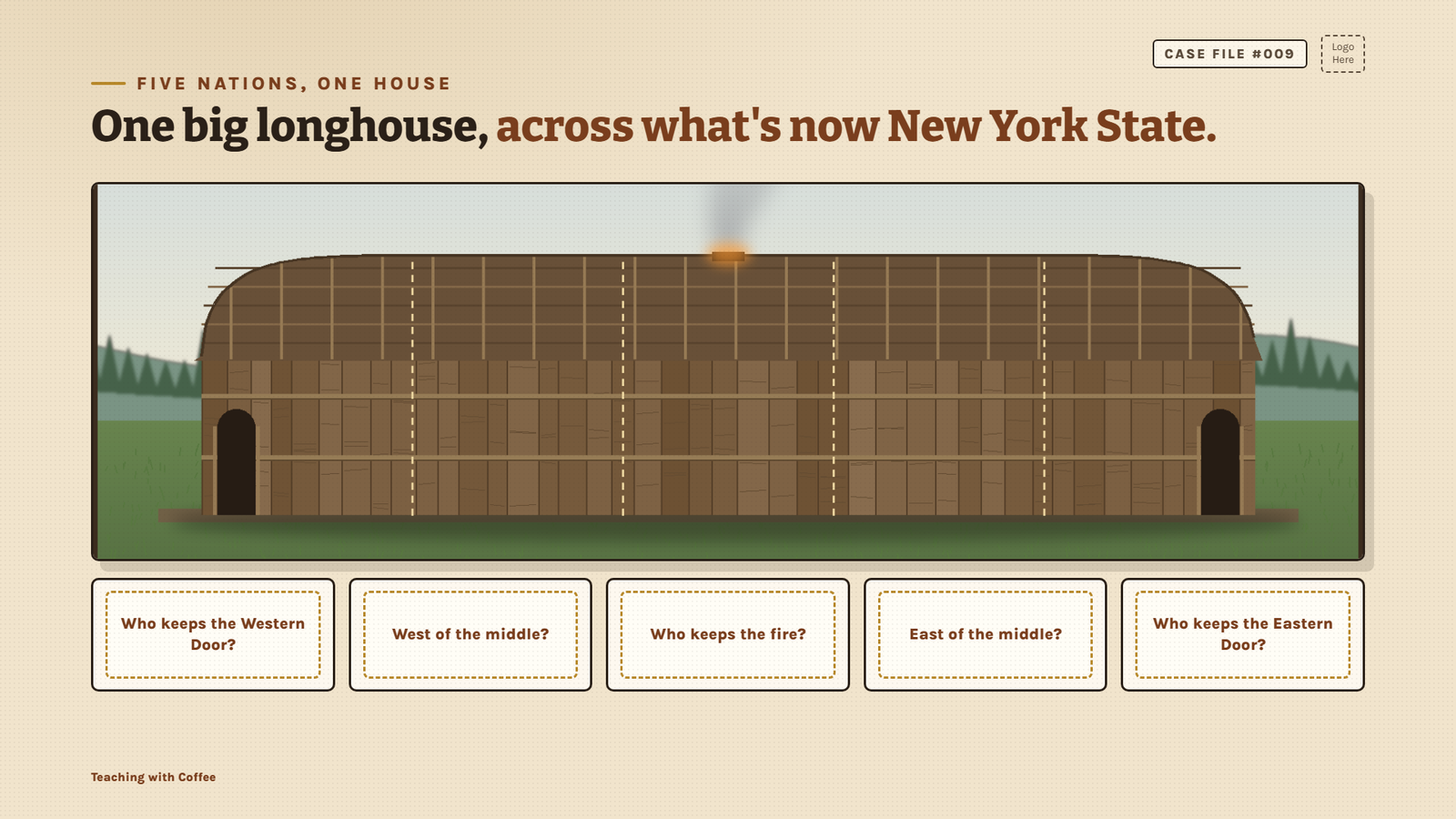
The name is also a map. The Haudenosaunee describe their union as one giant longhouse stretching across what is now New York State. The Mohawk keep the Eastern Door, the Seneca keep the Western Door, and the Onondaga, in the middle, keep the council fire. The Oneida and Cayuga live in between. If your class studied longhouses already, this is the bridge: same people, new lens.
Tell the founding story as they tell it
The Haudenosaunee tell of five nations at war, and of a messenger called the Peacemaker who brought a message of peace, power and a good mind. Hiawatha, grieving the loss of his family, carried the message from nation to nation. Jigonsaseh was the first to accept it. Tadodaho, the hardest to convince, finally agreed and became chair of the council. The nations buried their weapons under a great white pine, the Tree of Peace, and agreed to the Great Law of Peace.
Two teaching notes. Frame it as their account (“The Haudenosaunee tell the story…”). And skip the founding year: historians’ estimates span centuries. It’s accurate to say the Confederacy was already in place when Europeans arrived.
Four questions for any government
Students ask the same four civics questions of both governments, then build one side-by-side chart:
| Question | Haudenosaunee Confederacy | United States |
|---|---|---|
| Who chooses the leaders? | Clan mothers choose the 50 chiefs, and can remove a chief who won’t listen after warning him | Citizens vote, and leaders can be voted out or impeached |
| How are decisions made? | Consensus: talk it through until everyone is “of one mind” | Majority vote: more than half wins |
| Where are the rules kept? | Spoken and memorized, with wampum belts to help record them | Written down in the Constitution |
| Who has a voice? | Men serve as chiefs; women, as clan mothers, choose them | It started with mostly white men who owned land, and grew over time |
Compare, don’t rank
The one rule for the whole week: neither government is “better” or “more advanced.” When students spot a difference, the follow-up question is always why does this way make sense for these people?
Students also hold both governments up to a short list of democratic principles: consent of the governed, equality before the law, rights people are born with, and the right to change the government. The interesting row is rights. The Great Law talks more about peace, a good mind and duties than about “rights.” Not matching our vocabulary isn’t the same as not having the idea, and that’s a great discussion for 10-year-olds.
For point of view, pairs read two short primary sources: one written by the Haudenosaunee about their own government, and the Preamble to the Constitution. Who is describing this government, and what do they put first?
“Didn’t the Constitution come from the Iroquois?”
Someone will ask. Here’s a short, honest answer. The colonists definitely knew about the Haudenosaunee union. In 1744 the Onondaga leader Canassatego urged colonial leaders to unite the way the Six Nations had, and Benjamin Franklin wrote about the Six Nations in 1751 while arguing the colonies should join together. In 1988, Congress passed a resolution recognizing the Confederacy’s contribution. But historians disagree about how much it shaped the Constitution itself.
So this lesson doesn’t ask where the U.S. got its ideas. It asks how two governments solved the same problems differently. Keep the answer short and get back to the chart.
End in the present tense
The Haudenosaunee Confederacy is still here. The Grand Council still meets today at Onondaga. Ending the week on that sentence does more against the “Native Americans are only in the past” misconception than any worksheet.
The week, ready to teach
Week 2 of our Native American Heritage Month unit, “Two Ways to Govern,” includes three video-led lessons, interactive slides, both primary-source cards with word help, a card sort, fact sheets and writing prompts for each of the four questions, and a Grade 6 compare-and-contrast extension. The lesson plan includes the scripted answer to the Constitution question.
Get Week 2: Haudenosaunee & U.S. Government · Get all 3 weeks · Try Week 1’s first lesson free
Next Sunday: was wampum really “Native American money”? A wampum belt lesson, and why we say ku.éex’ instead of potlatch.
at the end of each November post. Kit form 10054634, social studies tag 24700581. –>Get a free Piper Hunter case file
Join our email list and we’ll send a free social studies lesson, plus first access to new weeks as they’re released.