Native American Regions for Kids: How Geography Shaped Homes, Food and Clothing
Ask a class why the Haudenosaunee lived in longhouses, and you’ll usually get “because that’s what they built.” Ask why the Tlingit didn’t need to farm, and you’ll get silence.
The fix isn’t more facts. It’s one question students can carry from region to region: what did this land offer, and what did it demand?
One lens, four parts
We teach every region with the same four words: home, food, clothing, geography. Geography comes first, because it explains the other three.
Here’s how the first lesson models it on the Woodland region, out loud, before students try it themselves:
Geography. Forests, rivers, four real seasons, good farmland.
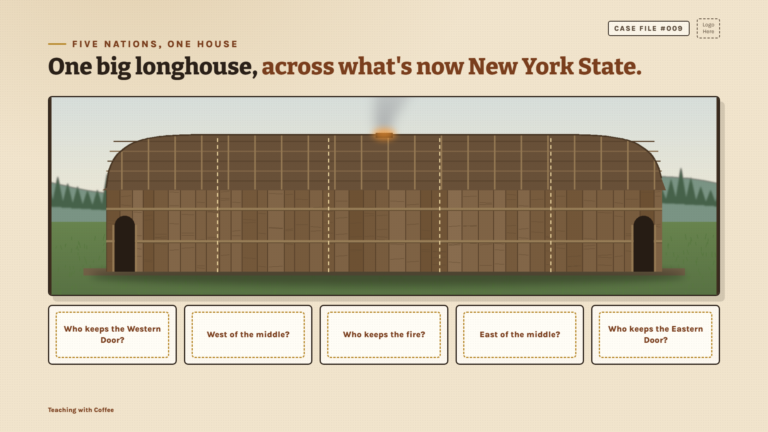
Home. The Haudenosaunee built longhouses, big wood-frame homes for several families. Wood was everywhere, and a big shared home was the answer to a hard winter.
Food. The Three Sisters: corn, beans and squash, grown together. Farming means staying in one place, and good soil and steady rivers made that possible.
Clothing. Deer hide and woven plant fiber, both things this land had plenty of.
Four questions, one answer each, and every answer traces back to the same geography. Once students see it done once, they can run it on any region.
Eight regions at a glance
Each region is taught through one well-documented nation. That’s a real limit, and we name it for students: there were hundreds of nations, and we’re studying a few closely.
| Region | Nation | The land | Home | Food |
|---|---|---|---|---|
| Woodland | Haudenosaunee | Forests, rivers, cold winters | Longhouses | Corn, beans and squash |
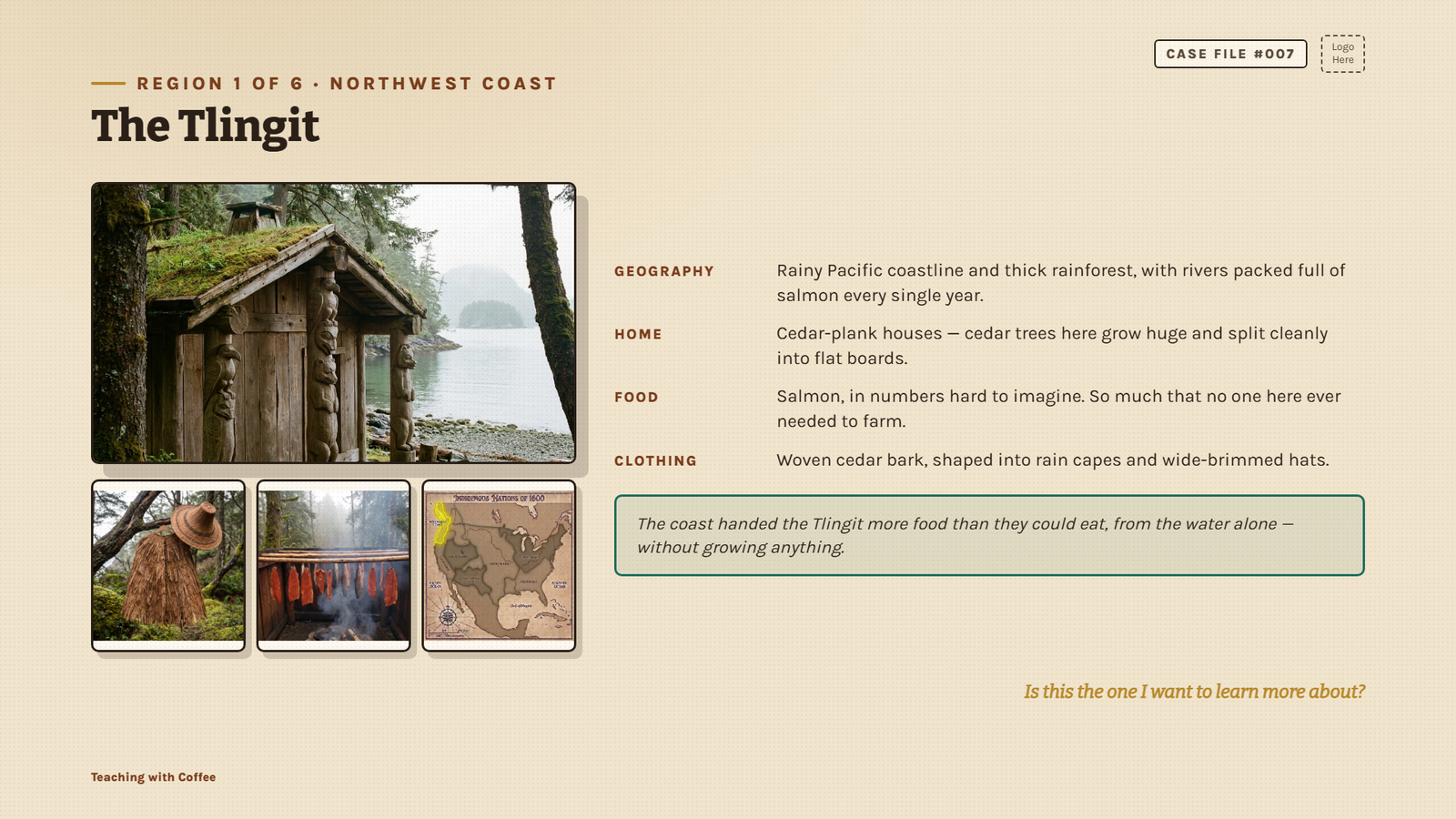
| Northwest Coast | Tlingit | Rainforest, mild wet weather, salmon rivers | Cedar plank houses | Salmon, smoked and dried to last the year |
| Great Plains | Mandan-Hidatsa | Grassland along the upper Missouri River | Earth lodges in permanent villages | River-bottom farming, buffalo hunted on foot |
| Southwest | Hopi | High desert mesas, very little rain | Pueblos of adobe and stone | Dry-farmed corn, beans and squash |
| Southeast | Cherokee | Warm, fertile river valleys, long growing season | Wattle-and-daub houses, a central council house | Farming, hunting, fishing, nuts |
| Great Basin | Shoshone | Dry high desert, big temperature swings | Wickiups, quick to build and leave | Pine nuts, seeds, roots, small game |
| Plateau | Nez Perce | Plateau cut by the Columbia and Snake rivers | Mat-covered longhouses in winter villages | Salmon, camas root, berries |
| California | Pomo | Clear Lake, oak hills, mild wet winters | Tule-reed lodges | Acorns, fish, waterfowl |
Look down the “Home” column and the pattern jumps out. Permanent homes show up where the land could feed people in one place all year. Quick, light shelters show up where people had to move to find food.
One accuracy trap: the Great Plains
When students picture the Plains, many picture riders on horseback following the buffalo. Our lessons are a snapshot of around 1600, before horses had spread across the Plains. So the region is taught through the Mandan-Hidatsa, who farmed the rich soil along the Missouri River and lived in earth lodges. It’s a good moment to ask, “How do we know when a picture is from?”
From notes to a real claim
In the last lesson of the week, students write one claim with evidence, using a frame like this:
“[Nation] built/ate/wore ___ because their region’s geography gave them ___ and demanded ___.”
A strong answer names a real feature of the land and says what it provided or demanded. “The Tlingit lived in cedar plank houses” is a fact. “The Tlingit built cedar plank houses because the rainforest gave them giant cedar trees” is a claim with evidence.
Then groups teach their region to the class, so by Friday every region has been covered, and students did the teaching.
Try it this week
The first lesson, which models the Woodland region with a short video and an interactive slide deck, is free. The full week adds the six-region survey, fact sheets and writing prompts for all eight regions, and a Grade 6 writing extension.
Get the free lesson · Get Week 1: Regions & Geography · Get all 3 weeks
Next Sunday: the same nation through a new lens. How the Haudenosaunee Confederacy governs, compared fairly with the United States.
at the end of each November post. Kit form 10054634, social studies tag 24700581. –>Get a free Piper Hunter case file
Join our email list and we’ll send a free social studies lesson, plus first access to new weeks as they’re released.