Was Wampum Money? A Wampum Belt Lesson, and Why We Say Ku.éex’ Instead of Potlatch
Plenty of us learned it in school: wampum was “Native American money.” It’s on worksheets, in trivia games and in some textbooks. It’s also not quite true, and figuring out why makes one of the best economics lessons you can teach in grades 4–6.
What wampum is
Wampum is white and purple shell beads, strung on cords or woven into belts. Purple beads were rarer. Each bead took hours to make by hand.
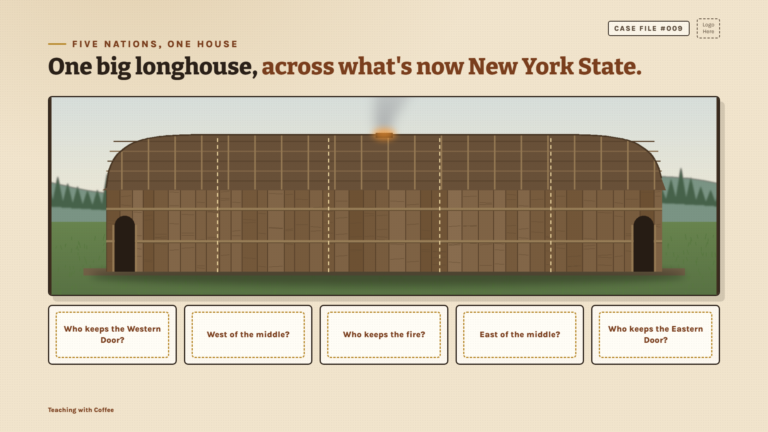
To the Haudenosaunee, wampum holds words. Belts record agreements. Strings carry messages and invitations. When a chief dies, the other side of the council fire brings strings of wampum to comfort the grieving side. In the Haudenosaunee story, Hiawatha is the one who first put words into the shells.
So what makes a wampum belt valuable? The promises it holds, the work of making it, and the trust between the people who exchange it.
The twist: the Dutch “followed the money”
Here’s where the myth comes from. Europeans traded for wampum so often that they started treating it as money. The Dutch colony of New Netherland was short of coins, so its leaders passed laws saying how many beads equaled a coin. Then metal drills made beads much faster, fake beads appeared, and the “price” kept falling.
Same shells, two completely different ideas of what they’re worth. The careful way to say it is “the Dutch used wampum like money,” not “wampum was money.” The Onondaga Nation puts it simply: wampum has always meant more than money.
Students read both sides for themselves: a Haudenosaunee account of bringing wampum to comfort a grieving family, and a 1650 Dutch law about wampum’s value and fake beads. Who wrote each one, and what does each say wampum is for? That’s point of view (RI.5.6) with real stakes.
Potlatch or ku.éex’?
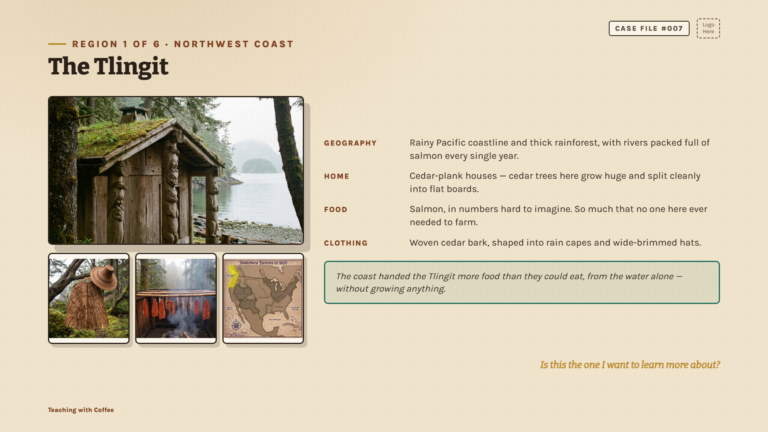
The second half of the week crosses the continent to the Tlingit of the Northwest Coast, and to a ceremony many of us learned to call a potlatch.
Here’s what most of us were never told. “Potlatch” isn’t a Tlingit word. It comes from Chinook Jargon, a trade language used along the coast between many nations and European traders, and it became a catch-all for the ceremonies of many different nations. The Tlingit have their own word, ku.éex’ (said roughly “koo-EEK”), and Tlingit Elders have asked people to use it. It’s the same idea as saying Haudenosaunee instead of Iroquois: call people and their practices by their own names.
We kept “potlatch” in our product title because it’s the word teachers search for. Inside the lesson, Piper explains the name once and then uses ku.éex’ only. The lesson plan includes a teacher background note, so you’re never caught off guard when a student says “my book calls it a potlatch.” (A good reply: “That’s right, a lot of books do. It’s a trade-language word. The Tlingit asked people to use their word, so we do.”)
What the ku.éex’ actually is
It’s often described as a party to show off wealth. It isn’t. A ku.éex’ is a memorial ceremony held about a year after someone dies, where food, gifts and money are given out. The family’s clan gives to guests from the opposite side, to end the year of mourning, remember the ancestors, and repay the other side for comforting the family and helping with the funeral. The guests serve as witnesses to the names and events of the ceremony.
Sort it out: alike or different?
After students have asked the same four questions about both (What is it? Who gives it, and to whom? Why is it given? What makes it valuable?), pairs sort statements like these:
- “Two sides look after each other.” Alike
- “Comforts people after a death.” Alike
- “It’s kept and read later.” Wampum only
- “It’s given away and used up.” Ku.éex’ only
- “Guests act as witnesses.” Ku.éex’ only
The surprise for most students: neither one was mostly about getting rich. Value came from promises, comfort and the people on the other side.
A good fit for Thanksgiving week
This week is three lessons, so it fits a short holiday week. The last lesson is also the unit assessment: one comparison claim with evidence and a “this matters because” sentence that explains what the comparison shows.
Get Week 3: Wampum Belts & Potlatch · Get all 3 weeks · See the whole unit
That wraps up our Native American Heritage Month series. Thank you for teaching these lessons with care. If you missed the first three posts, start with the 3-week plan.
at the end of each November post. Kit form 10054634, social studies tag 24700581. –>Get a free Piper Hunter case file
Join our email list and we’ll send a free social studies lesson, plus first access to new weeks as they’re released.